How can energy density reveal dimensions?
Use energy per unit volume to find the dimensions of an electric-field expression.
We’ll learn how to solve this JEE Main question:
If (1/2)ε₀E² has dimensions MᵃLᵇTᶜ, what is 2a − b + c? Here ε₀ is vacuum permittivity and E is electric field.
Adapted from JEE Main, 2 April 2026, Shift 1, Q26. You need force, work and powers of numbers. We’ll explain what dimensions mean and why this expression describes energy per volume.
What do the letters measure?
A dimension tells us what kind of quantity we are measuring. We use M for mass, L for length and T for time. These letters are not the units kilogram, metre and second; they describe the underlying quantities, regardless of the units chosen.
Speed is distance divided by time, so its dimensions are LT⁻¹. Acceleration is speed divided by time, so its dimensions are LT⁻². Square brackets are a short way to say “the dimensions of”: for example, [acceleration] = LT⁻².
Force equals mass times acceleration. Its dimensions are therefore MLT⁻². Work is force multiplied by distance in the direction of the force, so energy has dimensions ML²T⁻².
Divide energy by volume
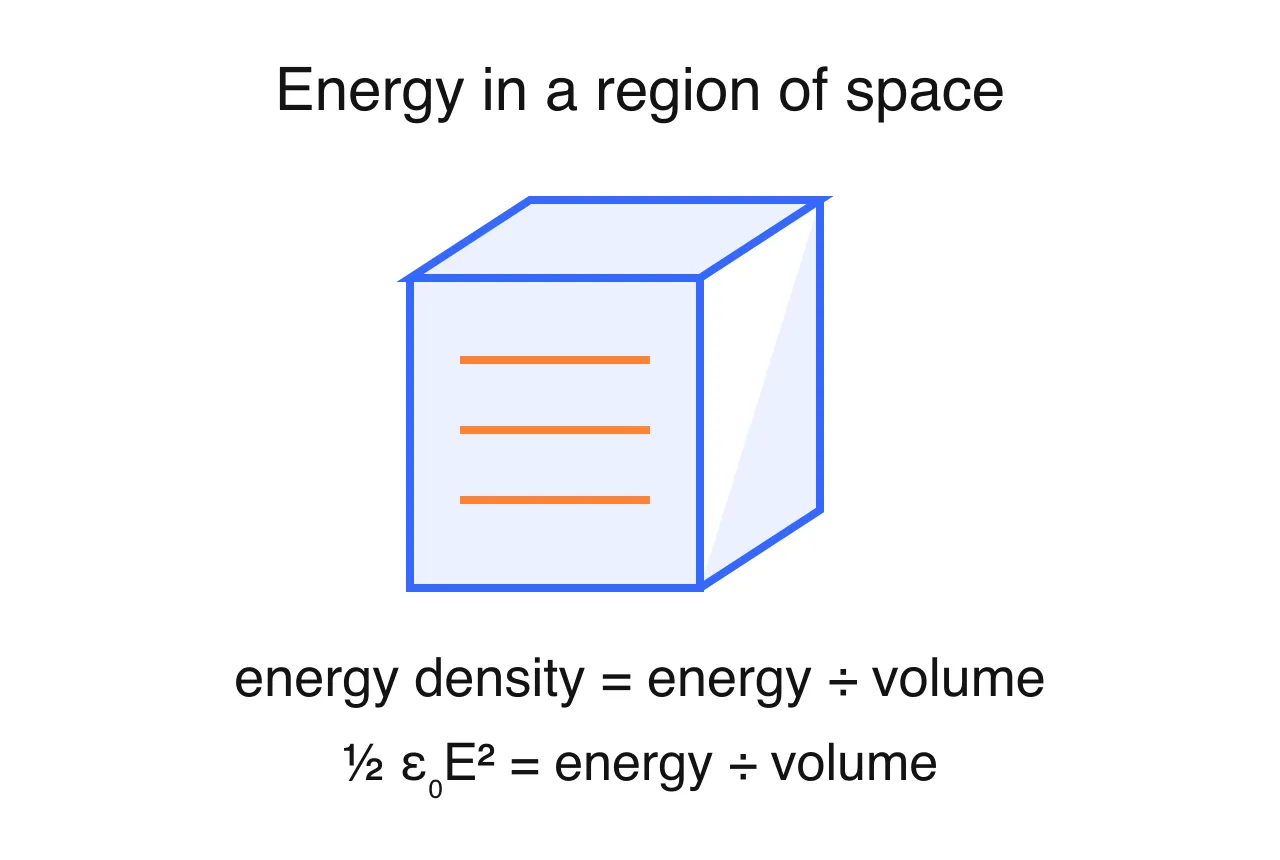
A charged capacitor stores energy in its electric field. Imagine a small region of space where that field is uniform. Its is the energy in the region divided by its volume. For an electric field in vacuum, this is (1/2)ε₀E², as described in OpenStax’s discussion of stored electric energy.
Volume has dimensions L³. So divide the dimensions of energy by L³. When dividing powers with the same base, subtract their exponents. We’ll use that step in the opening question at the end.
The factor 1/2 is a pure number: it changes the amount, but it has no dimensions. The same is true of π. In contrast, ε₀ is a physical constant with dimensions; we cannot simply discard it. We use the meaning of the whole expression instead.
The capacitor connections lesson looks at how capacitors combine. Here we are asking a different question: what kind of physical quantity an expression measures.
A different set of dimensional building blocks
The next past question uses Planck’s constant h as one of its building blocks. From energy = h × frequency, and frequency = 1/time, we get [h] = [energy] × T = ML²T⁻¹.
Newton’s gravitational relation F = Gm₁m₂/r² gives [G] = [force] × L²/M² = L³M⁻¹T⁻². To write this using h, divide [G] by [h]. The remaining factors show what must multiply h. This is a change of dimensional building blocks, not a claim that G numerically equals h times those factors.
Try the past questions
1. Express the dimensions of the gravitational constant G using Planck’s constant h, length L, mass M and time T.
Adapted from JEE Main, 2 April 2026, Shift 2, Q26.
Show hint
Divide L³M⁻¹T⁻² by the dimensions of h, which are ML²T⁻¹.
Show solution
The ratio [G]/[h] is (L³M⁻¹T⁻²)/(ML²T⁻¹) = LM⁻²T⁻¹. Multiplying by h gives [G] = [h L M⁻² T⁻¹].
Check by substituting the dimensions of h: (ML²T⁻¹)(LM⁻²T⁻¹) = L³M⁻¹T⁻², the dimensions required by Newton’s law.
2. Return to our opening question. If (1/2)ε₀E² has dimensions MᵃLᵇTᶜ, what is 2a − b + c? Here ε₀ is vacuum permittivity and E is electric field.
Show hint
Use energy divided by volume. The L exponent is 2 − 3.
Show solution
The expression is electric energy per volume. Its dimensions are (ML²T⁻²)/L³ = ML⁻¹T⁻².
Thus a = 1, b = −1 and c = −2. Substitution gives 2a − b + c = 2(1) − (−1) − 2 = 1.
Both answers agree with the NTA final key, question IDs 691121176 and 69112126.