How can sums of squares give standard deviation?
You do not need every value in a data set. Its sum and sum of squares can tell you the spread.
We’ll learn how to solve this JEE Main question:
For ten numbers x₁, x₂, …, x₁₀, the sum of all (xᵢ + 2)² is 180 and the sum of all (xᵢ − 1)² is 90. What is their standard deviation?
Adapted from JEE Main, 4 April 2026, Shift 2, Q8. Here i labels each of the ten numbers; “sum of all” means add the expression once for each number. You need averages, square roots and the expansion of (x + a)².
The question does not tell us the ten numbers. We will see why two totals are enough to find their spread.
Measure distance from the mean
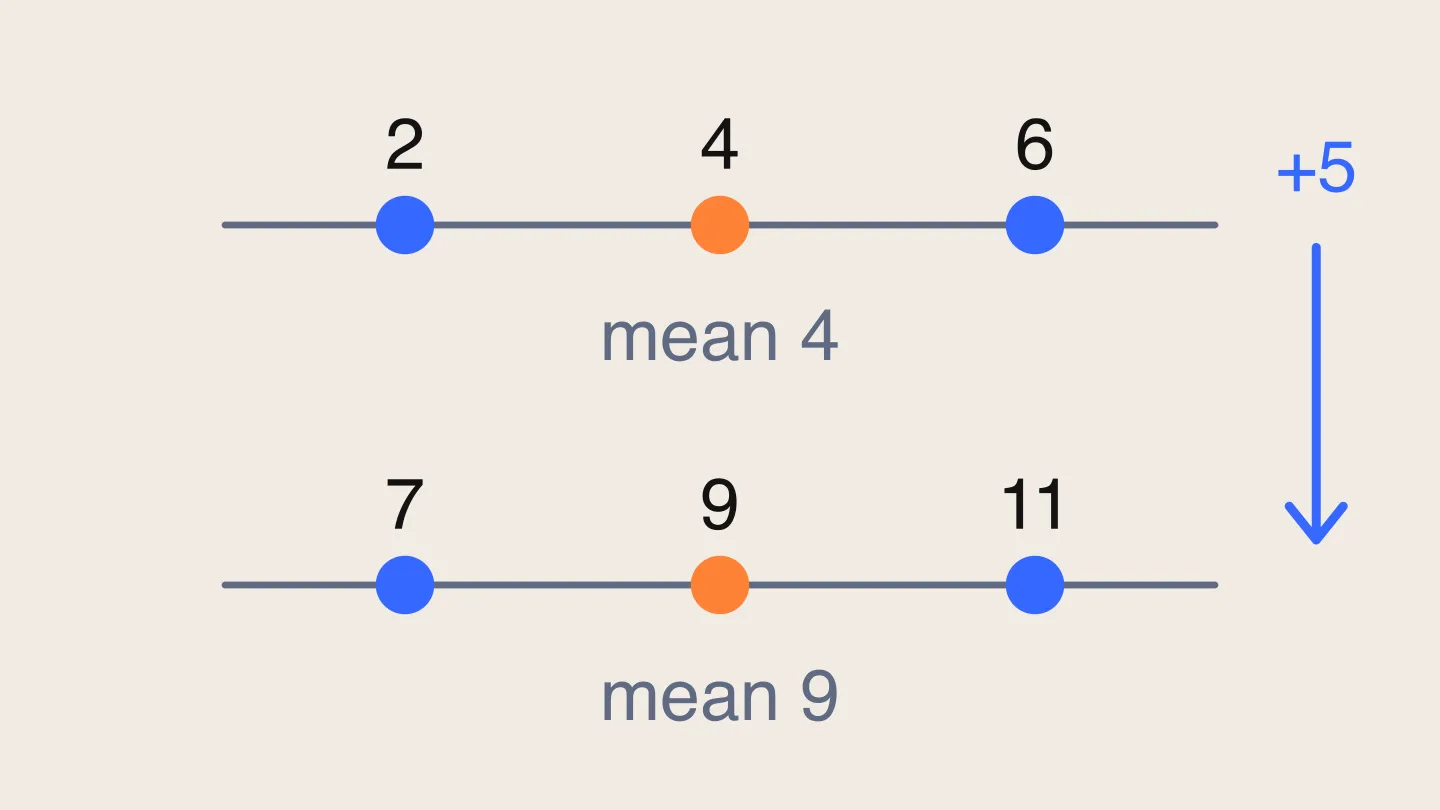
Take the three numbers 2, 4 and 6. Their mean is (2 + 4 + 6)/3 = 4. Their differences from the mean are −2, 0 and 2.
Adding those differences gives zero, even though the numbers are spread out. The negative and positive differences cancel. To measure spread without this cancellation, square each difference: 4, 0 and 4. Then take the average.
That average is the . For 2, 4 and 6, it is (4 + 0 + 4)/3 = 8/3. Standard deviation is the non-negative square root of variance: √(8/3).
These JEE questions ask for the variance of the given data, so we divide by the number of values, n. The n − 1 formula used to estimate a population variance from a sample is a different calculation.
A shift changes the mean, not the spread
Add 5 to each of our three numbers. They become 7, 9 and 11, and their mean becomes 9. Their differences from their new mean are still −2, 0 and 2.
Their variance is unchanged. But their squares are much larger. This tells us that simply averaging x² cannot measure spread about the mean: we must remove the effect of where the mean sits.
Keep just two totals
Let S be the sum of the n values, and let T be the sum of their squares. The mean is S/n. The useful relation is:
Variance = T/n − (S/n)².
In words: the mean of the squares, minus the square of the mean. These are different quantities. For our numbers 2, 4 and 6, S = 12 and T = 4 + 16 + 36 = 56. The formula gives 56/3 − 4² = 8/3, just as before.
Why does it work? Write the mean as m. Each squared difference is (x − m)² = x² − 2mx + m². When we add this expression for all n values, the three parts become T − 2mS + nm². Because S = nm, this simplifies to T − nm². Dividing by n gives T/n − m².
The OpenStax variance formula gives the same relation. The interpretation as average squared distance from the mean is also illustrated in Stanford’s lesson on variability.
Expand the shifted squares
Return to the kind of information in our opening question. Expanding (x + a)² gives x² + 2ax + a². When this is added for n values, the result is:
Sum of all (x + a)² = T + 2aS + na².
The constant a² appears n times, once for every value. Missing that multiplier is an easy way to get a wrong answer.
For ten values, the sum of (x + 2)² is T + 4S + 40. The sum of (x − 1)² is T − 2S + 10. Both equations contain the same T, so subtracting one from the other will remove it. That leaves an equation for S.
Try the past questions
1. A set of n values has mean 8 and variance 16. The first n − 1 values add to 48, and their squares add to 496. How many values are there?
Adapted from JEE Main, 2 April 2026, Shift 2, Q9.
Show hint
The full sum is 8n. Subtract 48 to find the last value. Use variance = T/n − 8² to find the full sum of squares.
Show solution
The last value is 8n − 48. Since 16 = T/n − 64, the full sum of squares is T = 80n.
Add the last value’s square to the known total: 496 + (8n − 48)² = 80n.
Expanding gives 64n² − 848n + 2800 = 0. Divide by 16 to get 4n² − 53n + 175 = 0, or (n − 7)(4n − 25) = 0.
The two roots are 7 and 25/4. A count of values must be a positive integer, so n = 7. The last value is then 8. Check: the full sum is 48 + 8 = 56, giving mean 8; the full sum of squares is 496 + 64 = 560, giving variance 560/7 − 64 = 16.
2. Return to our opening question. For ten numbers x₁, x₂, …, x₁₀, the sum of all (xᵢ + 2)² is 180 and the sum of all (xᵢ − 1)² is 90. What is their standard deviation?
Show hint
Write the two equations in S and T. Subtract them to find S, then substitute back to find T.
Show solution
The first total gives T + 4S + 40 = 180. The second gives T − 2S + 10 = 90.
Subtract the second equation from the first: 6S + 30 = 90. Therefore S = 10 and the mean is S/10 = 1.
Put S = 10 into the second equation: T − 20 + 10 = 90, so T = 100.
The variance is T/10 − 1² = 10 − 1 = 9. The question asks for standard deviation, so take the square root: √9 = 3.
Check the supplied totals: 100 + 4(10) + 40 = 180, and 100 − 2(10) + 10 = 90. Both agree.
Both answers agree with the NTA final key: question IDs 691121159 and 695278383.