How do you compare Bohr orbit radii?
Compare the orbit number and nuclear charge to find equal radii in one-electron species.
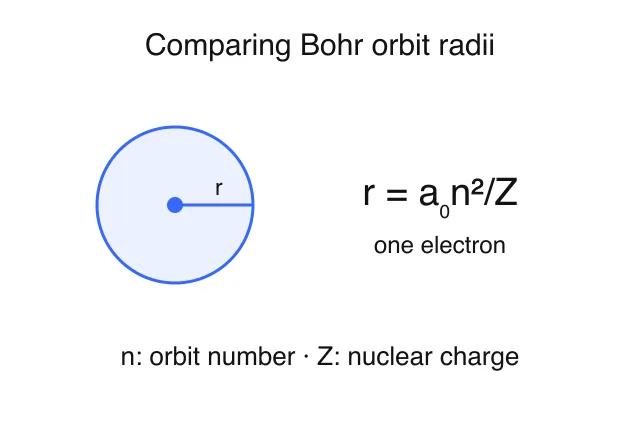
We’ll learn how to solve this question:
In the Bohr model, which two have equal orbit radii: H in its first orbit, He⁺ in its first or second orbit, Li²⁺ in its first orbit, or Be³⁺ in its second orbit?
Adapted from JEE Main, 4 April 2026 Shift 2 Q52. We’ll compare the allowed orbit radii using the orbit number and nuclear charge. You need squares and ratios.
One electron, different nuclei
Hydrogen has one electron. So do He⁺, Li²⁺ and Be³⁺: each ion has lost all but one of its electrons. Their nuclei have different numbers of protons. We write that number as Z: it is 1 for H, 2 for He, 3 for Li and 4 for Be.
The Bohr model describes the electron using allowed circular orbits. Label an orbit by the positive whole number n: n = 1 is the first orbit and n = 2 is the second. This is a useful model for these exam calculations, though the modern quantum description does not treat an electron as travelling on a fixed circular track.
For a one-electron species, the Bohr orbit radius is:
r = a₀n²/Z.
Here a₀ is the radius of the first Bohr orbit of hydrogen, about 52.9 pm. A picometre (pm) is 10⁻¹² m. OpenStax derives this relation and discusses the model’s limits.
Compare the factors
The constant a₀ is the same in each calculation. To compare radii, calculate n²/Z for each species. If those factors match, the radii match in this model.
For H in the first orbit, n²/Z = 1²/1 = 1. For Be³⁺ in the second orbit, n²/Z = 2²/4 = 1. Both radii are a₀. The larger orbit number increases the radius by a factor of four, while the larger nuclear charge divides it by four.
Be careful to square n before dividing by Z. A second orbit does not simply double the first orbit’s radius for the same nucleus: it has four times the radius.
Try the past questions
1. A one-electron species has a Bohr orbit radius of 70.53 pm. Using a₀ = 52.9 pm, which listed choice fits: Li²⁺ at n = 3, He⁺ at n = 3, He⁺ at n = 2, or Li²⁺ at n = 2?
Adapted from JEE Main, 6 April 2026, Shift 2, Q52.
Show hint
Calculate n²/Z for each listed choice, then multiply by 52.9 pm.
Show solution
For Li²⁺ at n = 2, Z = 3 and n²/Z = 4/3. Its radius is 52.9 × 4/3 = 70.53 pm to two decimal places.
The other choices give 158.7 pm, 238.05 pm and 105.8 pm, respectively. The matching choice is Li²⁺ at n = 2.
2. Return to our opening question: which two of the five listed orbits have equal radii?
Show hint
In the listed order, calculate n²/Z for H, He⁺, He⁺, Li²⁺ and Be³⁺.
Show solution
The factors are 1, 1/2, 2, 1/3 and 1. The first and fifth match.
So H in its first orbit and Be³⁺ in its second orbit have equal radii in the Bohr model.
The answers agree with the NTA final key, question IDs 6911211252 and 695278427.