How do you find a constant term in a binomial?
Balance powers of x before calculating the coefficient in a binomial expansion.
We’ll learn how to solve this JEE Main question:
In the expansion of (9x − 1/(3√x))¹⁸ for x > 0, the term independent of x is 221k. What is k?
Adapted from JEE Main, 4 April 2026, Shift 2, Q9. You need powers, square roots and combinations; we’ll use the binomial theorem to connect them.
A term independent of x has no changing power of x left in it. We can find that term without writing out the entire expansion.
Choose from each factor
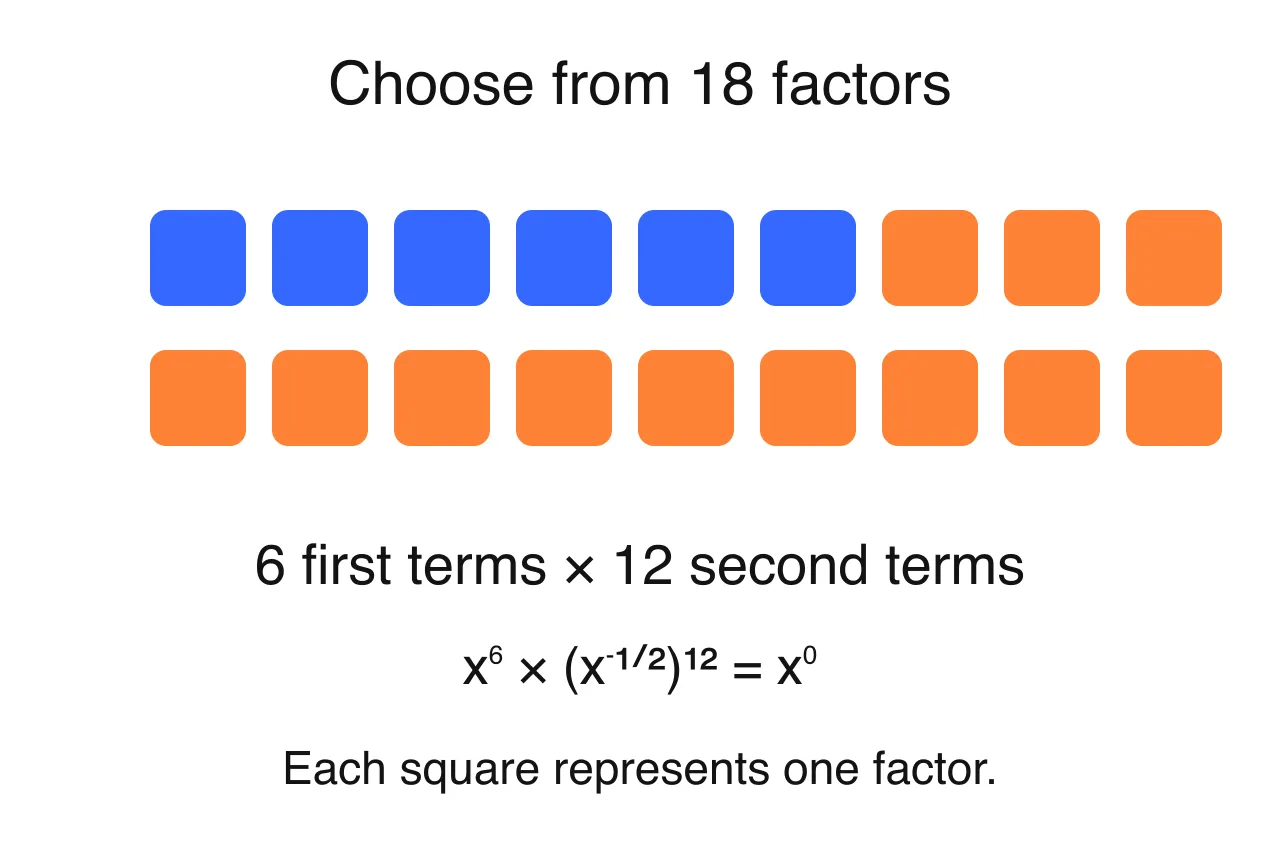
The power 18 means multiplying 18 identical factors. From each factor (9x − 1/(3√x)), choose either the first part or the second part. Multiplying the 18 choices gives one contribution to the expansion.
Suppose we choose the second part r times. Then we choose the first part 18 − r times. The number of ways to choose which r factors supply the second part is the C(18, r).
All choices with that same count give the same product. Their combined term is:
C(18, r) × (9x)¹⁸⁻ʳ × (−1/(3√x))ʳ.
Here r is an integer from 0 to 18. The general rule for the coefficient and powers follows from the binomial theorem.
Balance the powers of x
Because x > 0, 1/√x is x⁻¹ᐟ². Each first-part choice contributes one power of x; each second-part choice contributes minus one half. For r second-part choices, the combined exponent is:
(18 − r) − r/2 = 18 − 3r/2.
A constant term has exponent zero. Set 18 − 3r/2 = 0, and use the resulting whole-number r in the full term. The exponent tells us which term to use. It does not yet tell us the coefficient: we must still include C(18, r), the numbers 9 and 1/3, and the minus sign.
For our opening expression, twelve second-part choices leave six first-part choices. Their x powers cancel. The minus sign is raised to an even power, so it contributes a positive sign. We’ll calculate the coefficient when we return to the question.
When two coefficients must cancel
Another question may ask for two coefficients whose sum is zero. Find the index r for each requested power separately. Consecutive indices have opposite signs when the second part of the binomial is negative. For their sum to be zero, their binomial coefficients must also have equal magnitude.
For adjacent coefficients, C(n, r + 1)/C(n, r) = (n − r)/(r + 1). Thus they are equal exactly when n − r = r + 1, or n = 2r + 1. This step assumes both indexed terms actually occur in the expansion.
Try the past questions
1. Let n be a positive integer. In (x⁻³ − x⁴)ⁿ, suppose the terms in x⁷ and x¹⁴ both occur and their coefficients add to zero. Find n.
Adapted from JEE Main, 5 April 2026, Shift 1, Q23. The adaptation explicitly requires both terms to occur: without that condition, both coefficients can be zero because neither power appears.
Show hint
If the negative x⁴ is chosen r times, the power of x is −3n + 7r. The indices for powers 7 and 14 differ by one.
Show solution
For x⁷, write −3n + 7r = 7. The x¹⁴ term uses r + 1 choices of −x⁴. Their coefficients are (−1)ʳC(n, r) and (−1)ʳ⁺¹C(n, r + 1).
For their sum to vanish, the adjacent binomial coefficients must be equal. Therefore n = 2r + 1. Substituting into −3n + 7r = 7 gives −3(2r + 1) + 7r = 7, so r = 10 and n = 21.
Both indices 10 and 11 lie between 0 and 21. Their coefficients have equal magnitudes and opposite signs, as required.
2. Return to our opening question. In the expansion of (9x − 1/(3√x))¹⁸ for x > 0, the term independent of x is 221k. What is k?
Show hint
Set 18 − 3r/2 to zero. Then include the number of ways to choose the r second-part factors.
Show solution
Setting 18 − 3r/2 = 0 gives r = 12. There are six first-part choices and twelve second-part choices.
The constant term is C(18, 12) × 9⁶ × (−1/3)¹². Since 9⁶ = 3¹², the numerical powers cancel; the sign is positive. The term is C(18, 12) = 18,564.
Because 18,564 = 221 × 84, the requested value is k = 84.
Both answers agree with the NTA final key, question IDs 695278323 and 695278384. The first question above includes the stated nonzero-terms condition.