How do you find partial pressures at equilibrium?
Track the moles of each gas before calculating its pressure, including an inert gas that stays in the flask.
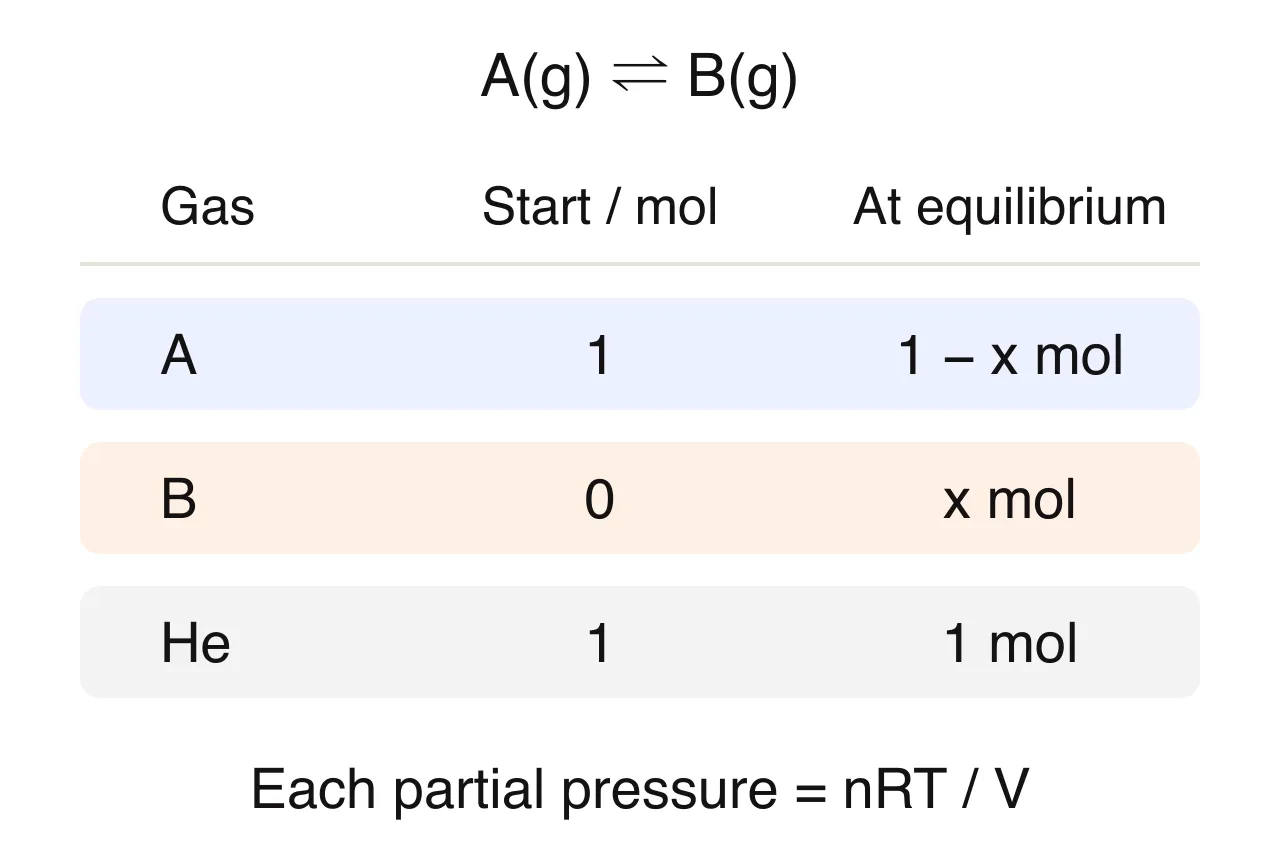
We’ll learn how to solve this question:
A 10 L flask initially contains 1 mol of helium and 1 mol of A, with no B. At 400 K, A(g) ⇌ B(g) has Kc = 4.0. Assuming ideal gases and R = 0.082 L atm K⁻¹ mol⁻¹, find the equilibrium partial pressures of helium and B.
Adapted from JEE Main, 6 April 2026 Shift 1 Q57, question ID 6952782192. We’ll keep track of every gas in the same rigid flask. You need the mole, simple ratios and the ideal-gas equation pV = nRT.
Count what changes in the flask
At chemical equilibrium, A continues changing into B and B continues changing back into A. The two rates are equal, so the amounts stop changing overall. Equilibrium does not mean that the two amounts must be equal.
Let x be the number of moles of A that change into B before equilibrium is reached. The reaction A ⇌ B uses one mole of A for each mole of B formed. Starting with 1 mol A and no B therefore gives 1 − x mol A and x mol B.
Helium does not take part in this reaction. Its amount stays at 1 mol. Keep that amount in the list even though helium will not appear in the equilibrium expression.
Use the equilibrium ratio to find the amounts
The concentration equilibrium constant for A(g) ⇌ B(g) is Kc = [B]/[A]. Square brackets mean concentration in moles per litre. There are no extra powers here because both reaction coefficients are one.
Both gases share the same volume V. Their concentrations are x/V and (1 − x)/V, so the common volume cancels: Kc = x/(1 − x). This ratio compares B with the A that remains. It does not compare B with the starting amount of A.
For example, if Kc were 3, there would be three moles of B for every mole of A at equilibrium. The starting mole would be split into four equal parts: one part A and three parts B. Apply that same reasoning to the actual Kc in the opening question.
Each gas contributes its own pressure
The partial pressure of one ideal gas is the pressure that gas would exert if it alone occupied the same volume at the same temperature. For gas i, pᵢ = nᵢRT/V. The subscript i simply labels which gas we mean.
All gases in our flask have the same T and V, so RT/V is a common multiplier. First find the moles of a gas, then multiply by RT/V. The total pressure is the sum of all these partial pressures, including helium’s.
For ideal gases at fixed temperature and volume, adding helium would raise the total pressure without changing p(A) or p(B). Their amounts and RT/V would be unchanged. That statement relies on fixed volume; keeping total pressure fixed while adding a gas would be a different situation.
Watch the total when one gas makes two
Now consider A(g) ⇌ B(g) + C(g), starting with a mol of A only. If x mol react, the equilibrium amounts are a − x, x and x. Adding them gives a + x mol in total. The total is no longer a, because each mole of A that reacts produces two moles of gas.
If total pressure p is supplied, each partial pressure is its mole fraction times p. Thus p(A) = p(a − x)/(a + x), while p(B) = p(C) = px/(a + x). The denominator must include every gas present.
For this reaction, the exam’s pressure expression is Kp = p(B)p(C)/p(A). In a fully dimensionless thermodynamic expression, each pressure is divided by a standard pressure p°. We will use the paper’s pressure convention below so that its algebraic options can be compared directly.
Try the past questions
1. A(g) ⇌ B(g) + C(g) starts with a mol of A only. At equilibrium, a − x mol of A remain and the total pressure is p. Express Kp in terms of a, x and p using the paper’s pressure convention.
Adapted from JEE Main, 5 April 2026 Shift 2 Q56, question ID 691121506; the options continue on page 23. Assume ideal gases and 0 < x < a.
Show hint
The total amount is a + x. Find the three partial pressures, then substitute them into p(B)p(C)/p(A).
Show solution
Substitution gives Kp = [px/(a + x)]² ÷ [p(a − x)/(a + x)]. Cancel one factor p and one factor a + x to obtain Kp = px²/(a² − x²).
Using a as the total amount would give the wrong denominator. If a dimensionless standard-pressure convention is required, replace p in this result by p/p°.
2. Return to the opening question: the 10 L flask has 1 mol helium and initially 1 mol A. For A ⇌ B at 400 K, Kc = 4.0. Find p(He) and p(B), using R = 0.082 L atm K⁻¹ mol⁻¹.
Show hint
Solve x/(1 − x) = 4. Then calculate RT/V once and multiply it by the amount of each requested gas.
Show solution
We have x = 4 − 4x, so x = 0.8 mol. The flask contains 0.2 mol A, 0.8 mol B and 1 mol helium. Also RT/V = 0.082 × 400/10 = 3.28 atm per mole.
Therefore p(He) = 3.28 atm and p(B) = 2.624 atm. As a check, p(A) = 0.656 atm, and p(B)/p(A) = 4. The three partial pressures sum to 6.56 atm.
The answers agree with the NTA final key, question IDs 691121506 and 6952782192.