How do you simplify a sum inside another sum?
Simplify one fraction at a time, then use finite-sum formulas and careful endpoints to add the whole series.
We’ll learn how to solve this question:
Find the sum of the first eight terms of 1³/1 + (1³ + 2³)/(1 + 3) + (1³ + 2³ + 3³)/(1 + 3 + 5) + ⋯.
Adapted from JEE Main, 2 April 2026 Shift 2 Q5. Each fraction contains smaller sums. We’ll simplify those before adding the fractions. You need basic algebra; the finite-sum formulas we use are given below.
Decide what counts as one term
The first term is the whole fraction 1³/1. The second term is the whole fraction (1³ + 2³)/(1 + 3). Adding another cube to the numerator and another odd number to the denominator creates the next term.
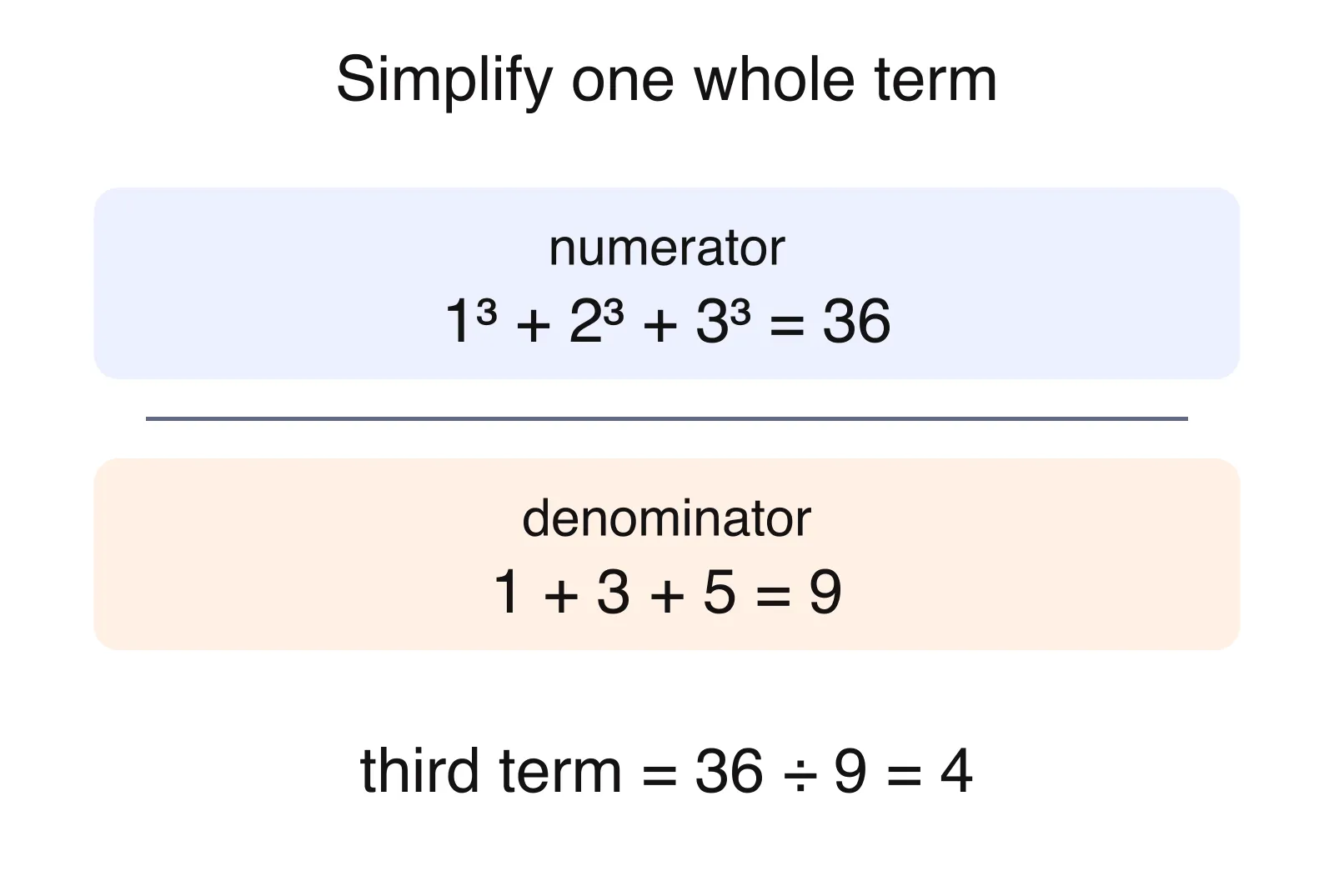
Take the third term. Its numerator is 1 + 8 + 27 = 36. Its denominator is 1 + 3 + 5 = 9. So the third term is 36/9 = 4. We have simplified one fraction; we have not yet found the total of the first three fractions.
This distinction matters because fractions are added as fractions. You cannot put every numerator into one large sum and divide by the sum of all the denominators. For example, 1/1 + 9/4 is 13/4, whereas (1 + 9)/(1 + 4) is 2.
Write the nth fraction
Let n be the position of a term: n = 1 for the first, n = 2 for the second, and so on. The nth numerator adds the cubes from 1³ to n³. The nth denominator adds the first n odd numbers, ending at 2n − 1.
The first n odd numbers add to n². One way to see this is to build a square from successive L-shaped strips: one cell makes a 1 × 1 square, three more make a 2 × 2 square, five more make a 3 × 3 square. Each new strip contains the next odd number.
The standard finite-sum identities we need are:
1 + 2 + ⋯ + n = n(n + 1)/2.
1² + 2² + ⋯ + n² = n(n + 1)(2n + 1)/6.
1³ + 2³ + ⋯ + n³ = [n(n + 1)/2]².
These hold for positive integers n. In particular, the sum of cubes is the square of the sum of integers. Check n = 3: 1³ + 2³ + 3³ = 36, and (1 + 2 + 3)² = 36 too.
Simplify before adding
Our nth fraction is [n(n + 1)/2]² divided by n². Squaring the numerator gives n²(n + 1)²/4. Since n is positive, we can cancel n². The result is simply (n + 1)²/4.
Check that formula against the third term: (3 + 1)²/4 = 4, agreeing with the direct calculation. The first term also checks: (1 + 1)²/4 = 1.
When n runs from 1 to 8, n + 1 runs from 2 to 9. So our final addition will involve the squares from 2² through 9². The square-sum formula starts at 1²; subtract that first square when using it for this range.
For another nested sum, the same method may leave a polynomial such as 2n² + 3n + 1. Add each part separately. The constant 1 appears once per term, so adding it over ten terms gives 10, not 1.
Try the past questions
1. Find the sum of the first ten terms of 1 + (1² + 2²)/2 + (1² + 2² + 3²)/3 + ⋯.
Adapted from JEE Main, 6 April 2026 Shift 2 Q6.
Show hint
The nth term is the sum of squares from 1² to n², divided by n. Cancel n before expanding.
Show solution
The nth term is (n + 1)(2n + 1)/6 = (2n² + 3n + 1)/6. For n from 1 to 10, the integers add to 55 and their squares add to 385.
The required sum is [2(385) + 3(55) + 10]/6 = 945/6 = 315/2. The first term is included by n = 1; it is not an extra term outside this total.
2. Return to our opening question: add the first eight fractions whose numerators are sums of cubes and denominators are sums of odd numbers.
Show hint
We found the nth fraction to be (n + 1)²/4. Its first square is 2² and its last is 9².
Show solution
The sum is (2² + 3² + ⋯ + 9²)/4. Using the square-sum formula, 1² + 2² + ⋯ + 9² = 9 × 10 × 19/6 = 285.
Remove 1², then divide by 4: (285 − 1)/4 = 71. As a direct check, the eight squares are 4, 9, 16, 25, 36, 49, 64 and 81; they add to 284.
The answers match the NTA final key, question IDs 6911211206 and 691121155.