How does the distance from a circle’s centre determine a chord?
Use a right triangle to connect a circle’s radius, a chord and the distance from its centre.
We’ll learn how to solve this question:
A circle passes through the origin. Its centre is where the perpendicular lines x + (k − 1)y + 3 = 0 and 2x + k²y − 4 = 0 meet. The line x − y + 2 = 0 cuts the circle at A and B. What is AB²?
Adapted from JEE Main, 2 April 2026 Shift 2 Q10. We’ll use a right triangle, then find the centre of the circle. You need the distance formula, perpendicular lines and simple algebra.
Draw a radius to the chord
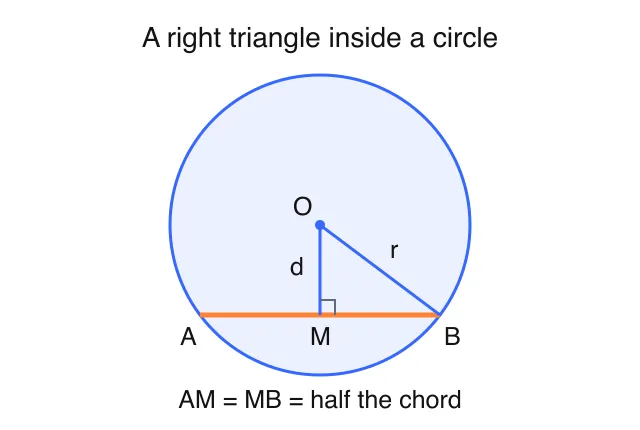
A chord is a straight line segment joining two points on a circle. Call its ends A and B and the centre O. Draw a perpendicular from O to the chord, meeting it at M. This perpendicular cuts the chord into two equal halves.
Now draw the radius OA. Triangle OMA is a right triangle. Its hypotenuse OA has length r, the radius. Let OM, the perpendicular distance from the centre to the chord, be d. Pythagoras gives:
(half the chord)² = r² − d², so AB² = 4(r² − d²).
For example, if r = 5 and d = 3, half the chord is √(25 − 9) = 4. The whole chord is 8. If the chord moves through the centre, d becomes zero and its length becomes 2r, the diameter. If d reaches r, the line just touches the circle and the chord length becomes zero.
Find the centre and the distance
For a line ax + by + c = 0, the perpendicular distance from a point (h, j) to the line is |ah + bj + c|/√(a² + b²). The absolute value makes the distance non-negative. The equation of a circle records its centre and radius; OpenStax reviews the circle and distance formulas.
Our opening question first asks us to find the centre. The two given lines are perpendicular, so their normal vectors are perpendicular too. Their normal vectors are (1, k − 1) and (2, k²). Their dot product must be zero:
2 + (k − 1)k² = 0.
The left side factors as (k + 1)(k² − 2k + 2). The second factor is (k − 1)² + 1, which is always positive for real k. Thus k = −1. We can now solve the two line equations for the centre and use the right triangle.
Try the past questions
1. A circle has its centre in the first quadrant and touches the x-axis at (3, 0). Its chord on the y-axis has length 6√3. Find the length of its chord on x − y = 3.
Adapted from JEE Main, 6 April 2026, Shift 2, Q10.
Show hint
Write the centre as (3, r). Use half the y-axis chord to find r, then calculate the perpendicular distance to x − y = 3.
Show solution
The centre is (3, r), with r positive. The distance to the y-axis is 3 and half its chord is 3√3. Hence r² = 3² + (3√3)² = 36, so r = 6.
The distance from (3, 6) to x − y − 3 = 0 is |3 − 6 − 3|/√2 = 3√2. The required chord is 2√(36 − 18) = 6√2.
2. Return to our opening question: what is AB² for the circle through the origin?
Show hint
Put k = −1 into the two centre lines. The origin is on the circle, so its distance from the centre is the radius.
Show solution
The centre lines become x − 2y + 3 = 0 and 2x + y − 4 = 0. Their intersection is O = (1, 2). The radius squared is 1² + 2² = 5.
The distance to x − y + 2 = 0 is |1 − 2 + 2|/√2 = 1/√2, so d² = 1/2. Thus AB² = 4(5 − 1/2) = 18.
The answers agree with the NTA final key, question IDs 6911211210 and 691121160.