If forces are equal, why do things move?
When you walk, your foot pushes the ground backwards and the ground pushes you forwards. Let’s see why these equal pushes do not stop you moving.
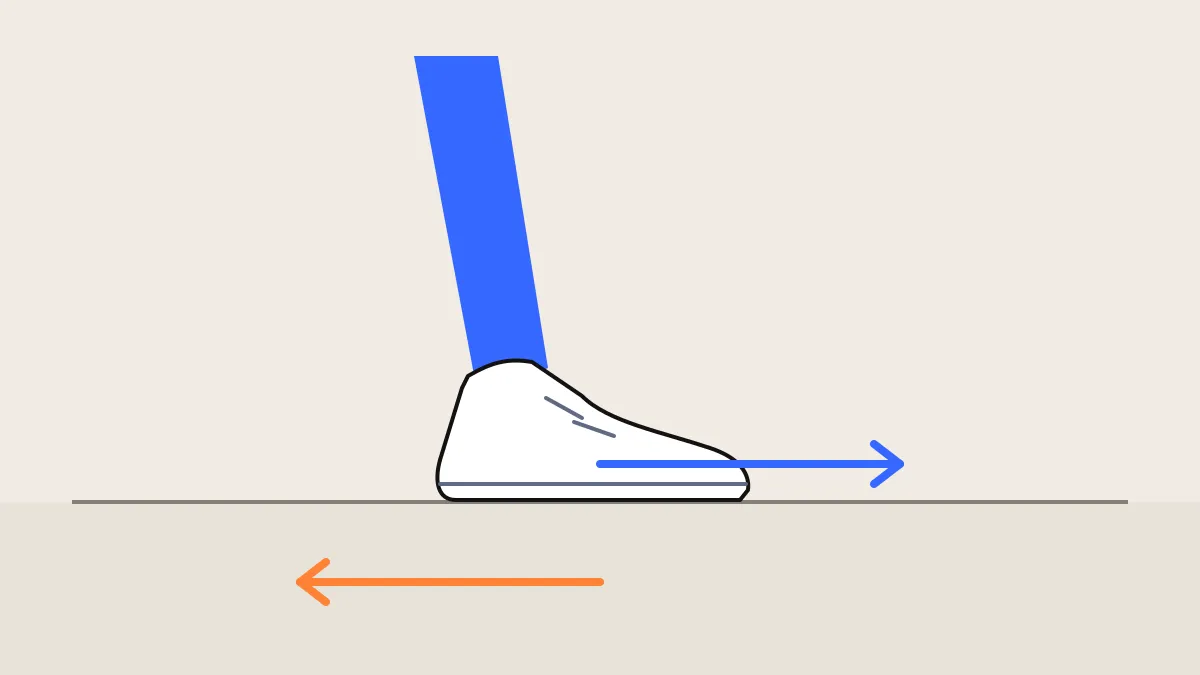
If every push has an equal push back, why can you still move? This is the question we’ll work through. We’ll follow one step and look at where each push acts.
In physics, a is simply a push or a pull on an object.
Start with a step
Think about taking a step forwards. As you push off, your shoe presses backwards against the ground. The ground pushes forwards on your shoe. That forward push helps you move.
The two pushes happen at the same time. They are equally strong, but one acts on your shoe and the other acts on the ground.
Look at the blue arrow on the shoe. It shows the ground pushing your shoe forwards. The orange arrow shows your shoe pushing the ground backwards. Notice that the arrows act on different things.
Why don’t they cancel?
For two forces to cancel, both must act on the same object. Here, that does not happen.
The forward push acts on you. The backward push acts on the ground. You are not receiving both pushes, so they do not cancel each other on your body.
That is the part to remember: equal pushes can still help something move when they act on different objects.
The ground needs to grip your shoe
The force that gives your shoe this grip is called . It keeps your shoe from slipping backwards as you push off.
On smooth ice, your shoe has much less grip. It can slip backwards, making it harder to get the forward push you need.
So why can you move? The ground pushes you forwards, while your equal push acts on the ground. Whenever you hear “equal and opposite”, ask: what is each force pushing?