When do linear equations have infinitely many solutions?
Use elimination to distinguish repeated information from a contradiction, then solve two JEE Main parameter questions.
We’ll learn how to solve this question:
The equations x + 5y + 6z = 4, 2x + 3y + 4z = 7 and x + 6y + az = b have infinitely many solutions. Which relation holds: b − a = 3, a − b = 3, a + b = 11, or a + b = 12?
Adapted from JEE Main, 2 April 2026 Shift 2 Q3, question ID 691121153. We’ll eliminate variables and see what the remaining equation says. You need only multiplication, subtraction and simple algebra.
Repeating information is different from contradicting it
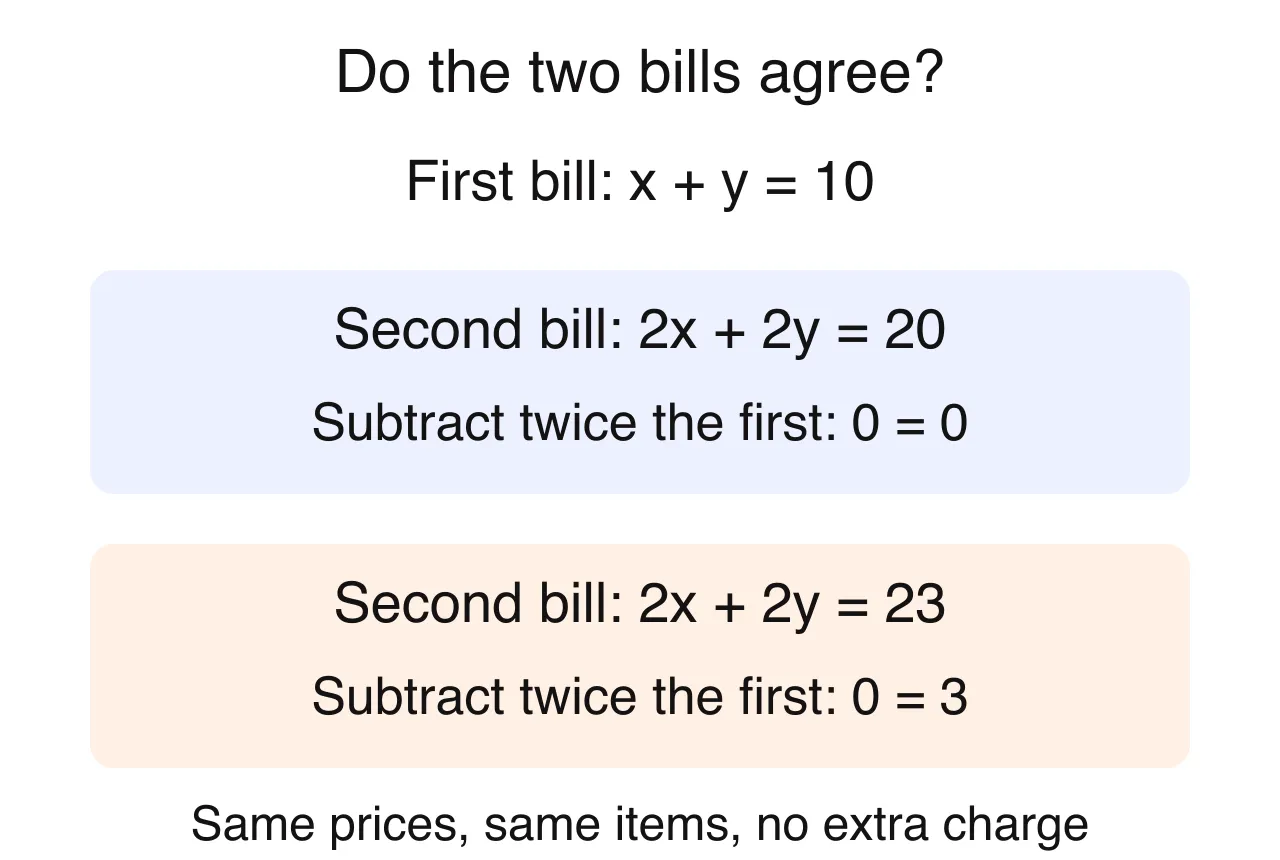
Suppose one apple costs x rupees and one orange costs y rupees. A bill tells us that an apple and an orange cost 10 rupees: x + y = 10. A second bill says two of each cost 20 rupees: 2x + 2y = 20.
The second bill repeats the first. Subtracting twice the first equation from the second gives 0 = 0. It adds no new restriction. We still cannot determine both prices separately.
Now suppose the second bill says two of each cost 23 rupees, with the same prices and no extra charges. Subtracting gives 0 = 3. No prices can satisfy both bills. That is a contradiction, so the system has no solution.
Keep both sides of an equation together
The same idea works with three unknowns. A solution is one triple (x, y, z) that satisfies every equation at once. We can replace an equation by itself minus a multiple of another equation without changing which triples satisfy the whole system.
This process is called elimination. We choose the multiple so that one variable disappears. Always subtract the right-hand sides too. Equal coefficients with unequal totals are exactly how a contradiction can appear.
For the opening question, call the equations R₁, R₂ and R₃ in the order shown. The notation R₂ − 2R₁ means subtract twice every term of the first equation from the second, including its right-hand side.
Reduce the last condition to one variable
The first two opening equations are x + 5y + 6z = 4 and 2x + 3y + 4z = 7. Subtracting twice the first from the second gives −7y − 8z = −1. We now have a relation between y and z, with x removed.
For any chosen z, this relation fixes y. The first equation then fixes x. So the first two equations allow a family of triples, one for each possible z. The third equation will decide whether to select one member, accept the whole family, or reject every member.
After eliminating x and y from that third condition, it will have the form Az = B. Here A and B are expressions involving the given parameters a and b. These capital letters are temporary names for the two sides, not extra unknowns.
If A is nonzero, z = B/A is fixed. If A = 0 but B is nonzero, the equation is impossible. If A = B = 0, this last equation places no restriction on z, so the family survives.
You may also see the coefficient determinant used. A nonzero determinant gives one solution. A zero determinant only tells you that the unique-solution method fails: you must still check whether the equations repeat information or contradict it.
Try the past questions
1. Let α and β be real numbers with α ≠ 0. The equations x + 2y + z = 5, 2x + y + αz = 5 and 8x + 4y + βz = 18 have no solution. Find β/α.
Adapted from JEE Main, 2 April 2026 Shift 1 Q3, question ID 6911213. We explicitly require α ≠ 0 so the requested ratio is defined; the original does not state that condition.
Show hint
Compare the third equation with four times the second. Their x and y terms will cancel.
Show solution
Subtracting four times the second equation from the third gives (β − 4α)z = 18 − 20 = −2. This becomes a contradiction precisely when β − 4α = 0. Thus β/α = 4, using α ≠ 0.
If β − 4α were nonzero, z would be fixed. The remaining x and y equations have independent coefficient pairs (1, 2) and (2, 1), so they would give a unique solution. If α = β = 0, the system would still be inconsistent, but β/α would be undefined; this explains the added condition.
2. Return to the opening question: x + 5y + 6z = 4, 2x + 3y + 4z = 7 and x + 6y + az = b have infinitely many solutions. Which of the four relations holds?
Show hint
We already have −7y − 8z = −1. Subtract the first original equation from the third, then multiply the result by 7 to eliminate y.
Show solution
R₃ − R₁ gives y + (a − 6)z = b − 4. Multiply this by 7 and add −7y − 8z = −1. The result is (7a − 50)z = 7b − 29.
For z to remain free, both sides must reduce to zero: a = 50/7 and b = 29/7. Therefore a − b = 3.
To check the freedom directly, put z = t. Then y = (1 − 8t)/7 and x = (23 − 2t)/7. Every real t satisfies all three equations with these a and b, so there are indeed infinitely many solutions.
The answers match the NTA final key, question IDs 6911213 and 691121153, with the ratio condition stated above.