When is a quadratic always positive?
Look at the lowest point of the curve, then use the discriminant to turn the picture into a condition.
We’ll learn how to solve this question:
Choose a, b and c independently and equally likely from 1, 2, 3 and 4. The probability that ax² + 2√2 bx + c is positive for every real x is m/n in lowest terms. What is m + n?
Adapted from JEE Main, 2 April 2026, Shift 1, Q23. We’ll first learn what “positive for every x” looks like, then count which choices make it happen. You need the quadratic formula and probability as favourable outcomes divided by total outcomes.
A curve that never reaches zero
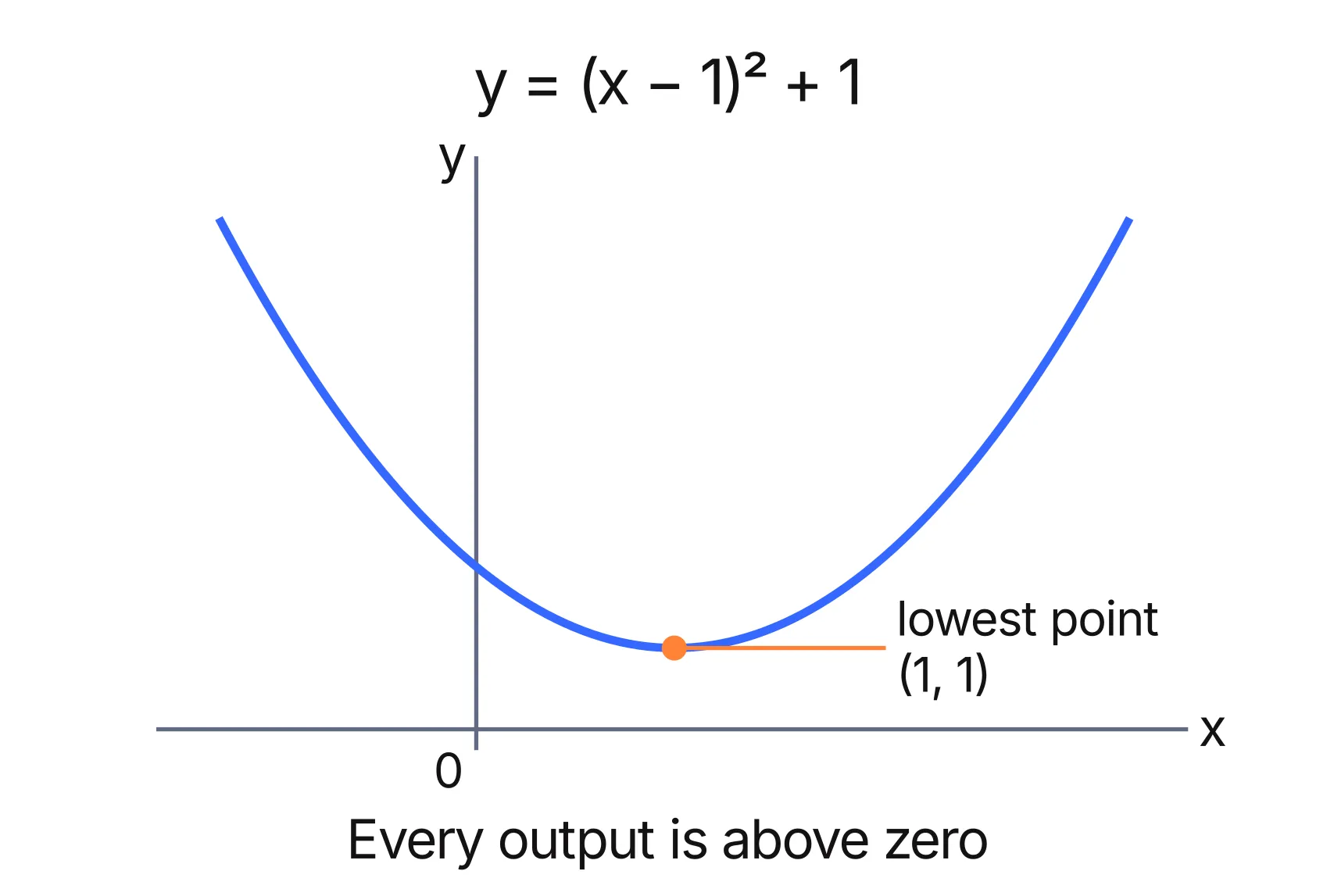
Start with y = (x − 1)² + 1. A real number squared is never negative, so (x − 1)² cannot be below zero. Adding 1 makes the whole expression at least 1.
The smallest value occurs at x = 1, where the square is zero. Everywhere else the square is positive and the output is larger. The curve therefore stays above the x-axis, as in this description of a quadratic’s minimum.
Now remove the final +1. The expression (x − 1)² touches zero at x = 1. It is never negative, but it is not positive for every x, because one output equals zero.
That small distinction matters in the exam question. “Positive” means strictly greater than zero. A curve that merely touches the x-axis does not qualify.
Turn the picture into a test
Write a general quadratic as Ax² + Bx + C. We are using capital letters here so that the coefficient B is easy to distinguish from the lowercase b in the opening question.
If A is positive, the curve opens upward. To keep every output positive, this upward curve must never touch or cross the x-axis. In other words, the equation Ax² + Bx + C = 0 must have no real roots.
The D = B² − 4AC tells us whether those roots exist. In the quadratic formula, √D appears. If D is negative, that square root is not real, so there are no real roots. If D is zero, there is one repeated real root: the curve touches the axis.
So the condition we need is A > 0 and D < 0. Both parts matter. A downward curve can have no real roots too, but it would sit entirely below the axis.
For the opening question, A = a, B = 2√2 b and C = c. The coefficient of x is the whole expression 2√2 b. When we square it, we get 8b². Since a is already positive, our condition becomes 8b² − 4ac < 0, or ac > 2b².
Count without listing every quadratic
There are four choices each for a, b and c, giving 4 × 4 × 4 = 64 equally likely ordered choices. We now need to count how many satisfy ac > 2b².
Fix one value of b at a time. For each a, ask which c values make the product large enough. For example, with b = 1 and a = 1, we need c > 2. Only c = 3 and c = 4 work.
The order matters: a = 1, c = 3 and a = 3, c = 1 are separate choices. Also notice that ac can never exceed 16. That observation will quickly rule out some values of b in the final solution.
Positive outputs or positive roots?
A related past question asks for two positive roots. Here, “positive” describes the x-values where the output is zero. It does not describe all the outputs of the quadratic.
To have positive real roots, first require D ≥ 0. Then require their sum and product to be positive. For Ax² + Bx + C = 0, the sum is −B/A and the product is C/A.
Why do those two signs work? A positive product means the two nonzero roots have the same sign. A positive sum then tells us they are both positive. This is a different test from keeping the entire curve above zero; read what the question is asking before choosing the condition.
Try the past questions
1. For λ ≠ −2, the equation (λ + 2)x² − 3λx + 4λ = 0 has two positive roots. How many integer values of λ are possible?
Adapted from JEE Main, 4 April 2026, Shift 2, Q5.
Show hint
Require real roots, a positive sum and a positive product. Keep the sign of λ + 2 in mind when solving the inequalities.
Show solution
The discriminant is 9λ² − 16λ(λ + 2) = −λ(7λ + 32). Requiring it to be nonnegative gives −32/7 ≤ λ ≤ 0.
The root sum is 3λ/(λ + 2), and the product is 4λ/(λ + 2). Both are positive when λ and λ + 2 have the same sign: λ < −2 or λ > 0.
Both requirements hold together only for −32/7 ≤ λ < −2. The integers in this interval are −4 and −3, so the answer is 2.
2. Return to the opening probability question. How many choices satisfy ac > 2b², and what is m + n?
Show hint
For b = 1, count pairs with ac > 2. For b = 2, count pairs with ac > 8. For larger b, compare the required product with its maximum, 16.
Show solution
When b = 1, the allowed c values number 2, 3, 4 and 4 as a takes the values 1, 2, 3 and 4. This gives 13 choices.
When b = 2, a = 1 and a = 2 give no choices. For either a = 3 or a = 4, c can be 3 or 4. This gives 4 choices.
For b = 3 or 4, the required product is greater than 18 or 32. Since ac is at most 16, neither value gives a choice.
There are 13 + 4 = 17 favourable choices out of 64. The probability is 17/64, already in lowest terms. Therefore m + n = 17 + 64 = 81.
Both answers match the NTA final key, question IDs 695278380 and 69112123.