Which side should you multiply by a matrix inverse?
Use ordered transformations to understand PA = B and AQ = B, then put the inverse on the side that cancels A.
We’ll learn how to solve this question:
Let A = [2, −2; 4, −2] and B = [3, 9; 1, 3], where the semicolon separates the two rows. If PA = B and AQ = B, find the absolute value of the sum of the diagonal entries of 2(P + Q).
Adapted from JEE Main, 2 April 2026 Shift 2 Q22, question ID 691121172. You need row-by-column multiplication and basic arithmetic with fractions. We’ll explain the inverse and the choice of side.
A matrix can describe an operation
Think of a column containing two numbers, x and y. A matrix can turn that input column into a new output column. For example, the matrix [1, 1; 0, 1] changes (x, y) into (x + y, y). Its first row adds the two input numbers; its second row keeps y.
Throughout this article, brackets list a matrix row by row, with a semicolon between rows. Thus [1, 1; 0, 1] has first row 1, 1 and second row 0, 1. A coordinate pair such as (x, y) represents a column when a matrix acts on it.
Now suppose a second operation doubles the first coordinate and leaves the second alone. Apply the first operation to (1, 1), then double: (1, 1) becomes (2, 1), then (4, 1). Reverse the order and the result changes: (1, 1) becomes (2, 1), then (3, 1).
The same two operations have produced different outputs. Matrix multiplication generally depends on order. If Av means “apply A to the column v”, then BAv means “apply A first, then B”. The matrix nearest the input acts first.
What does an inverse undo?
The identity matrix I leaves every input unchanged. For two coordinates, I = [1, 0; 0, 1]. An invertible matrix A has an inverse A⁻¹ that undoes its operation: AA⁻¹ = A⁻¹A = I.
For the operation (x, y) → (x + y, y), the inverse subtracts the second coordinate from the first. It changes (u, v) into (u − v, v). Applying these operations consecutively returns the starting pair.
An inverse is not found by taking the reciprocal of every entry. For A = [a, b; c, d], first calculate the determinant ad − bc. If this is nonzero, the inverse formula gives A⁻¹ = [d, −b; −c, a]/(ad − bc). The division applies to every entry in the bracket.
If ad − bc is zero, this inverse does not exist. Check that condition before trying to cancel A.
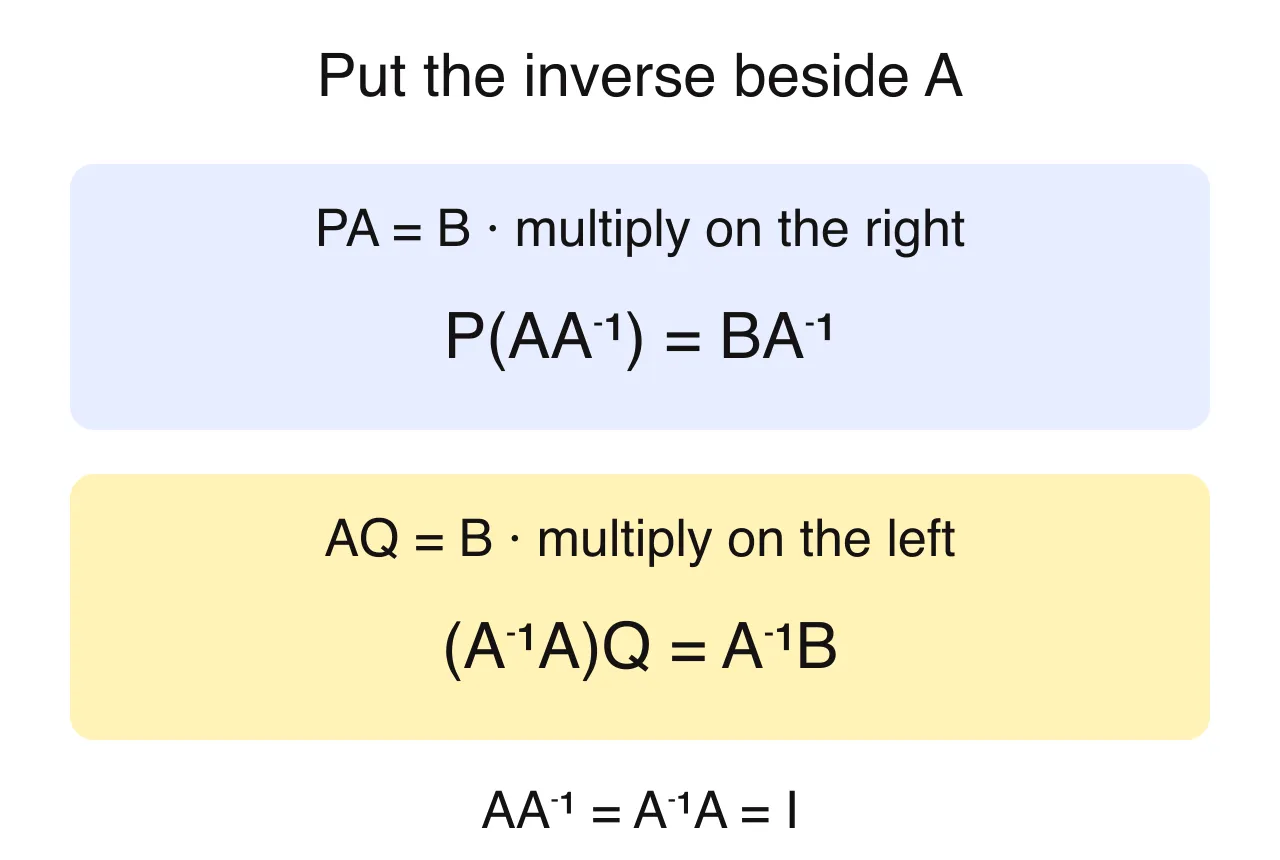
Put the inverse beside the matrix it must cancel
In PA = B, A is on the right of P. Multiply both sides on the right by A⁻¹. This gives PAA⁻¹ = BA⁻¹, so P = BA⁻¹. The neighbouring A and A⁻¹ become I, and PI = P.
In AQ = B, A is on the left of Q. Multiply both sides on the left by A⁻¹ instead. This gives A⁻¹AQ = A⁻¹B, so Q = A⁻¹B.
Multiplying PA = B on the left would give A⁻¹PA = A⁻¹B. The inverse cannot pass through P to reach A. That equation is valid, but it has not isolated P.
Columns tell you what a matrix does
A matrix times the column (1, 0) gives its first column. Multiplying it by (0, 1) gives its second column. These inputs pick out one column at a time because all the other weights are zero.
The same idea works for three coordinates. If a matrix M has columns c₁, c₂ and c₃, then M(x, y, z) = xc₁ + yc₂ + zc₃. This lets us recover a matrix from the outputs of (1, 0, 0), (0, 1, 0) and (0, 0, 1).
Once the columns are known, an equation Mv = b can be solved by v = M⁻¹b when M is invertible. For a small numerical question, expanding into ordinary equations can be quicker. Both methods must reproduce b when the answer is substituted back.
Try the past questions
1. A matrix M sends the columns (1, 0, 0), (0, 1, 0) and (0, 0, 1) to (1, 2, 3), (0, 1, 2) and (−1, 1, 1), respectively. If M(x, y, z) = (1, 7, 11), find x + y + z.
Adapted from JEE Main, 5 April 2026 Shift 2 Q4, question ID 691121454. All triples represent columns, as in the original question. You need basic elimination of simultaneous equations for the short solution below.
Show hint
The given outputs are the three columns of M. Expand x(1, 2, 3) + y(0, 1, 2) + z(−1, 1, 1) = (1, 7, 11).
Show solution
The three rows give x − z = 1, 2x + y + z = 7, and 3x + 2y + z = 11. Subtract twice the second equation from the third: −x − z = −3, so x + z = 3.
Combining x + z = 3 with x − z = 1 gives x = 2 and z = 1. Then y = 2, and x + y + z = 5. Substitution gives (1, 7, 11), as required.
2. Return to the opening question: A = [2, −2; 4, −2], B = [3, 9; 1, 3], PA = B and AQ = B. Find the absolute value of the diagonal sum of 2(P + Q).
Show hint
Find A⁻¹, then use P = BA⁻¹ and Q = A⁻¹B. The main diagonal of a two-by-two matrix contains its top-left and bottom-right entries.
Show solution
The determinant of A is 2(−2) − (−2)(4) = 4. Hence A⁻¹ = [−1/2, 1/2; −1, 1/2]. Multiplication gives P = [−21/2, 6; −7/2, 2] and Q = [−1, −3; −5/2, −15/2].
The diagonal sum of P is −21/2 + 2 = −17/2. For Q it is −1 − 15/2 = −17/2. The diagonal sum of 2(P + Q) is therefore 2(−17/2 − 17/2) = −34. Its absolute value is 34.
P and Q have the same diagonal sum here, but they are different matrices. Multiplying back confirms PA = B and AQ = B. Equal diagonal sums do not make matrix multiplication interchangeable.
The answers agree with the NTA final key, question IDs 691121454 and 691121172.