Why does dividing by a half make the answer bigger?
Two metres of ribbon can make four half-metre pieces. Counting those pieces explains what dividing by a half means.
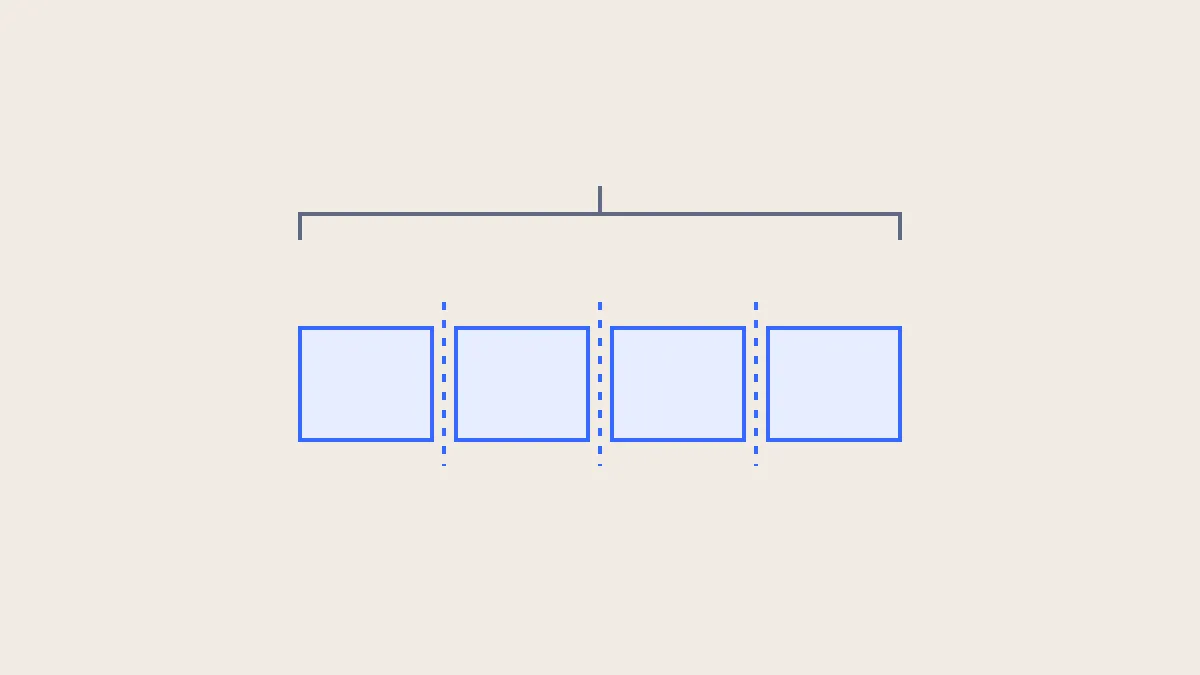
Division often seems to make an answer smaller. So why does 2 ÷ ½ give 4?
Here is the question we’ll learn to solve: how many half-metre pieces can we cut from a 2-metre ribbon? We’ll count the pieces first, then connect that count to 2 ÷ ½.
Count the half-metre pieces
A means one of two equal parts. Cut the first metre of ribbon into two equal pieces. Each piece is half a metre long. Do the same with the second metre, and you get two more pieces.
That makes four pieces altogether.
So the answer to our question is four half-metre pieces. We write the calculation as 2 ÷ ½ = 4.
Here, tells us how many pieces we can make. The 2 is the ribbon’s length in metres. The ½ is the length of each piece in metres. The answer, 4, is the number of pieces.
Try both piece sizes in the picture. You can make two 1-metre pieces or four half-metre pieces. In both cases, you started with the same 2 metres of ribbon.
Smaller pieces, more pieces
The ribbon has not grown. We get a bigger count because we are making smaller pieces. Every 1-metre piece can be cut into two half-metre pieces, so the number of pieces doubles.
This explains the shortcut “divide by ½, multiply by 2”. Each whole contains two halves, so we multiply the number of wholes by two to count the halves.
“Divide by two” asks a different question
Now take the same 2-metre ribbon and ask for two equal pieces. Each will be 1 metre long. This is 2 ÷ 2 = 1.
The questions are different. In 2 ÷ 2, we choose the number of equal pieces and find their length. In 2 ÷ ½, we choose the length of each piece and find how many we can make.
For our original question, each piece must be half a metre long. Four such pieces fit into 2 metres, so 2 ÷ ½ = 4.