Why does half-neutralisation give pH close to pKa?
Follow the amounts of weak acid and its conjugate base to understand the half-neutralisation point.
We’ll learn how to solve this JEE Main question:
A 20 mL acetic-acid sample needs 28.4 mL of 0.1 M NaOH for complete neutralisation. What is the pH after adding only 14.2 mL of that NaOH, given pKa = 4.75?
Adapted from JEE Main, 4 April 2026, Shift 2, Q55. You need moles, molarity and logarithms; we’ll explain the acid–base relationship below.
The added volume is half the volume needed for complete neutralisation. But half-neutralisation does not mean the solution has pH 7. First we need to see what is left in the flask.
Follow the acid as base is added
Acetic acid is a weak acid: in water, only a small fraction gives up a hydrogen ion on its own. Call one acetic-acid particle HA. When it gives up H⁺, the remaining acetate ion is A⁻, its conjugate base.
NaOH supplies hydroxide ions, OH⁻. Each OH⁻ reacts with one HA to make water and one A⁻:
HA + OH⁻ → A⁻ + H₂O.
This reaction changes the amounts in a predictable way. If one mole of OH⁻ reacts, one mole of HA is consumed and one mole of A⁻ is formed. Sodium ions remain in solution; they do not change that one-to-one count.
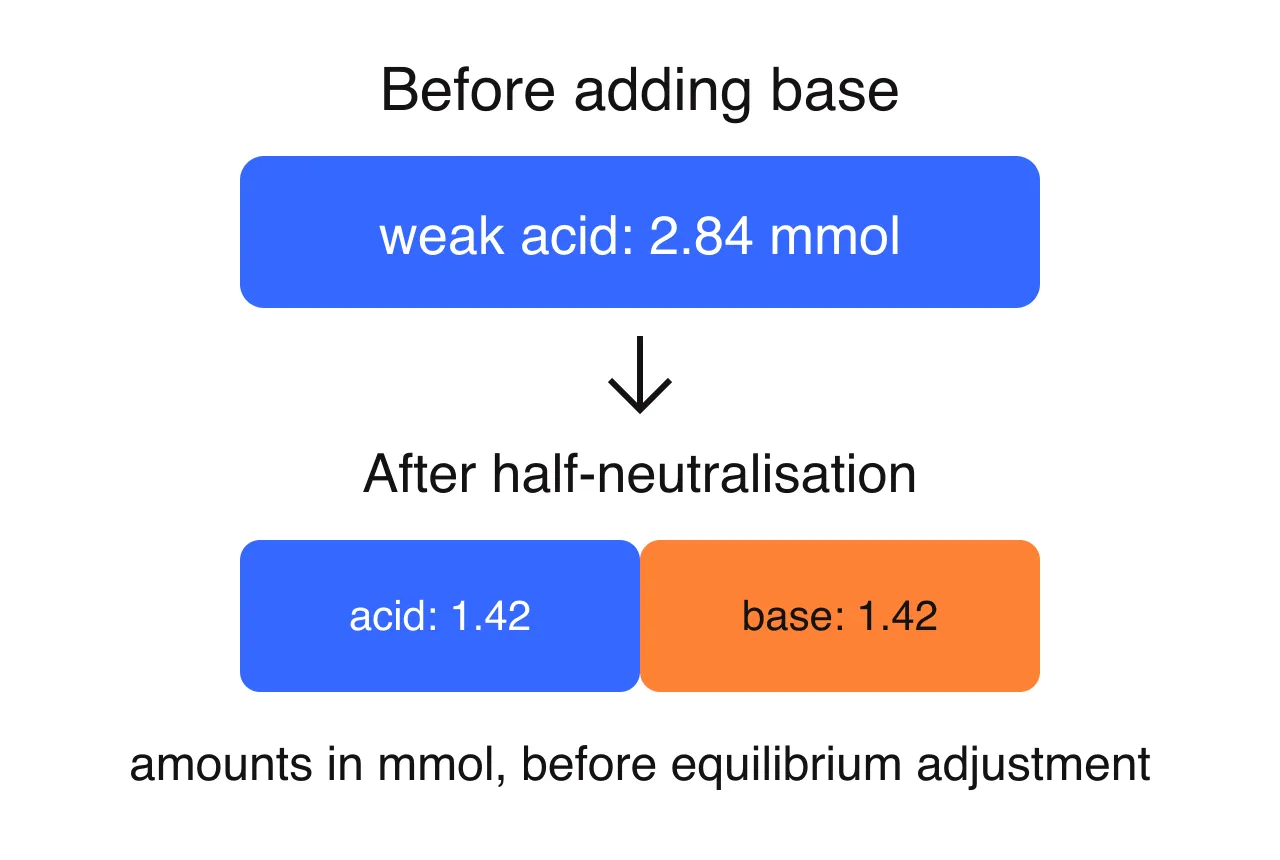
At the point, half of the starting acid has reacted. The other half remains as HA, while the reacted half has become A⁻. The two amounts are equal, before the small equilibrium adjustment.
Connect the ratio to pH
The mixture of weak acid and conjugate base forms a buffer. For a suitable dilute solution, we use the Henderson–Hasselbalch relation:
pH ≈ pKa + log₁₀([A⁻]/[HA]).
The square brackets mean equilibrium concentrations. pKa is −log₁₀Ka, where Ka describes the acid’s tendency to donate a hydrogen ion. The relation follows from Ka = [H⁺][A⁻]/[HA], after taking logarithms.
For the usual buffer approximation, we estimate the equilibrium concentrations from the amounts left after the neutralisation reaction. Both are in the same final volume, so their concentration ratio is approximately their mole ratio. At half-neutralisation the ratio is about 1. Since log₁₀(1) = 0, pH is approximately pKa.
This is not a statement that all halfway points have pH 7. The pH depends on the particular acid’s pKa. The approximation assumes a sufficiently dilute solution with appreciable amounts of both acid and conjugate base; it can fail for extreme dilution or when the small equilibrium adjustment is not negligible. See OpenStax’s buffer discussion.
Before any base is added
The second past question also asks for the starting pH. Initially there is weak acid but no added conjugate base, so the buffer approximation above is not the right starting calculation.
If the initial acid concentration is c and the fraction ionised is small, write [H⁺] ≈ √(Ka c). Then pH = −log₁₀[H⁺]. After half-neutralisation, use the equal acid/base amounts instead. Keep those two stages separate.
Try the past questions
1. At 25 °C, 20.0 mL of 0.2 M weak monoprotic acid HX is titrated with 0.2 M NaOH. Find the approximate pH before base is added and after 10.0 mL is added. Use Ka = 5 × 10⁻⁴, pKa = 3.3 and the small-ionisation approximation.
Adapted from JEE Main, 2 April 2026, Shift 2, Q56.
Show hint
Use √(Ka c) for the initial hydrogen-ion concentration. Compare initial acid moles with the moles of added NaOH for the second stage.
Show solution
Initially [H⁺] ≈ √((5 × 10⁻⁴)(0.2)) = 0.01 M. Thus the initial pH is approximately 2.0.
There are initially 20.0 × 0.2 = 4.0 mmol of acid. The added base supplies 10.0 × 0.2 = 2.0 mmol of OH⁻. Half the acid reacts, leaving equal acid and conjugate-base amounts. The second pH is approximately pKa = 3.3.
2. Return to our opening question. A 20 mL acetic-acid sample needs 28.4 mL of 0.1 M NaOH for complete neutralisation. What is the pH after adding only 14.2 mL of that NaOH, given pKa = 4.75?
Show hint
The same NaOH concentration is used in both volumes. How much of the acid has reacted when the added volume is half the full-neutralisation volume?
Show solution
Complete neutralisation requires 28.4 × 0.1 = 2.84 mmol of OH⁻, so the sample initially has 2.84 mmol of acid. Adding 14.2 mL supplies 1.42 mmol of OH⁻.
That leaves 1.42 mmol of acid and produces 1.42 mmol of acetate. Their approximate concentration ratio is 1, so pH ≈ pKa + log₁₀(1) = 4.75.
Both answers agree with the NTA final key, question IDs 691121206 and 695278430.