Why does mgh fail far above Earth?
Follow the changing gravitational pull as a mass rises, then calculate energy using distance from Earth’s centre.
We’ll learn how to solve this question:
A mass m is moved from Earth’s surface to a height 2R above it. Earth’s radius is R and its surface gravitational acceleration is g. What is the increase in gravitational potential energy?
Adapted from JEE Main, 5 April 2026 Shift 2 Q32, question ID 691121482. We’ll follow one small payload moving away from a spherical Earth. Ignore Earth’s rotation and other bodies. You need fractions and the idea that energy can change between potential and kinetic forms.
A long climb does not have a constant weight
Near the ground, lifting a payload through a height h increases its gravitational potential energy by approximately mgh. Here m is the payload’s mass and g is the gravitational acceleration near the surface. This works because the pull hardly changes over a small height.
But the opening question takes the payload much farther away. As we saw when looking at gravity above Earth, the pull becomes weaker as the distance from Earth’s centre grows. Using the surface value of mg for the whole climb would overestimate the work needed.
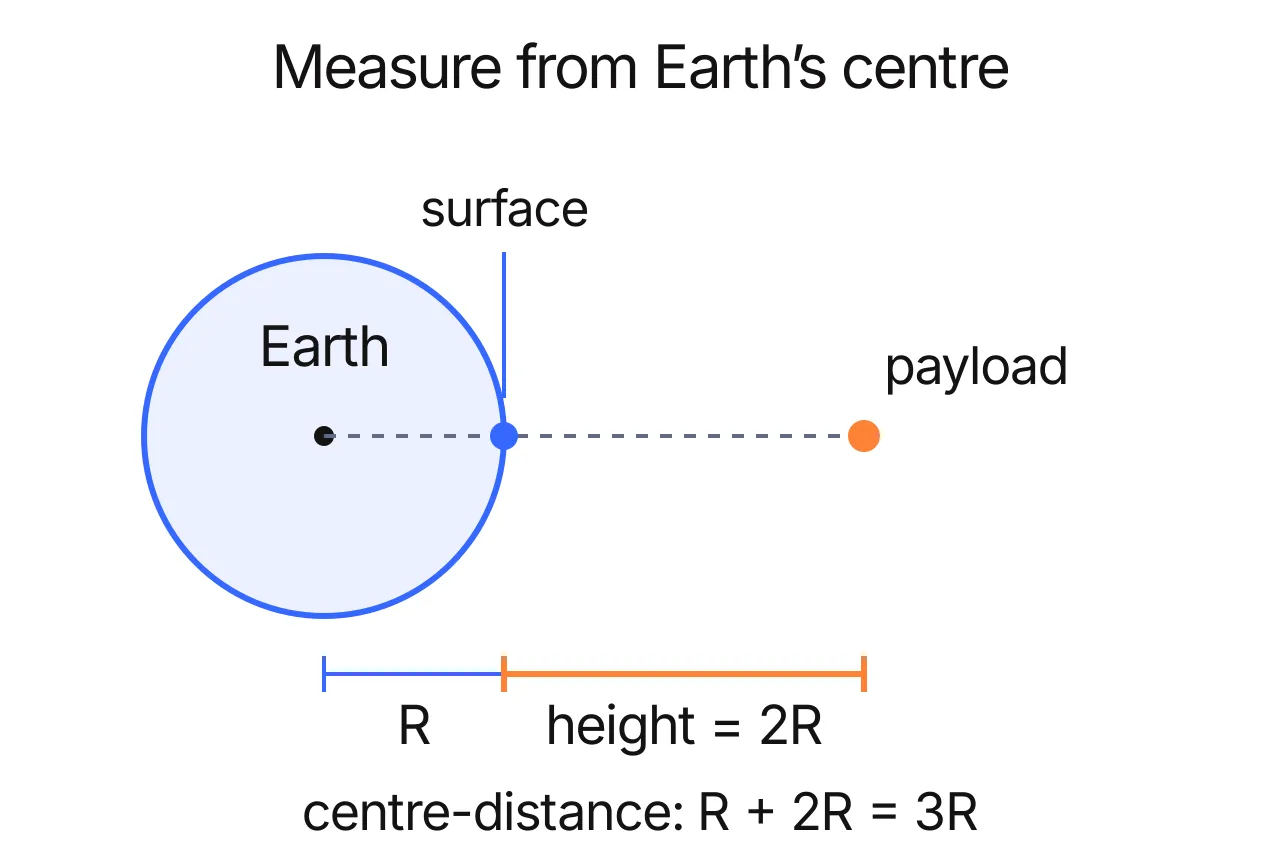
Keep two distances separate. R is Earth’s radius. A height h is measured from the surface, so the distance from the centre is r = R + h. For the opening journey, mark the starting and finishing distances before doing any energy calculation.
Choose a useful zero for energy
Gravitational potential energy belongs to the Earth–payload pair. We choose its value to be zero when the two are infinitely far apart. With this choice, the energy at a centre-distance r is U = −GMm/r. G is the gravitational constant and M is Earth’s mass. This expression applies outside a spherical Earth.
The minus sign follows from the chosen zero. Separating the two masses requires energy, so a pair at a finite distance has less potential energy than the infinitely separated pair. As the payload rises, U becomes less negative. That is an increase: −3 is greater than −9.
To find the change, subtract the starting energy from the finishing energy. For centre-distances r₁ and r₂, this gives ΔU = GMm(1/r₁ − 1/r₂). If r₂ is larger than r₁, the bracket is positive, as a climb requires.
Connect this expression with mgh
At Earth’s surface, g = GM/R², so GM = gR². This substitution lets us answer a question that supplies g and R instead of G and M.
For any height h above the surface, put r₁ = R and r₂ = R + h. Simplifying gives ΔU = mgRh/(R + h). When h is much smaller than R, the factor R/(R + h) is almost 1, and we recover mgh. For a large height, that factor matters.
There is another useful check. As h grows without bound, the required increase approaches mgR. It does not grow without bound like mgh. The gravitational pull keeps weakening during the outward journey.
Follow the energy during a fall
Now let the payload fall freely. With no air resistance or other energy transfer, its total mechanical energy K + U stays constant. K = ½mv² is its kinetic energy. As U decreases, K increases by the same amount.
This gives the speed without treating g as constant throughout the fall. Write the starting K + U and the finishing K + U, then set the totals equal.
Try the past questions
1. A 1 kg body starts from rest infinitely far from Earth and falls to its surface. Neglect air resistance. Find its speed and kinetic energy there, using R = 6400 km and g = 9.8 m/s².
Adapted from JEE Main, 2 April 2026 Shift 2 Q31, question ID 691121181. The starting rest condition and idealised fall are stated explicitly here.
Show hint
At the starting point, both K and U are zero. At the surface, U = −mgR. Convert the radius to metres.
Show solution
Energy conservation gives K − mgR = 0. Thus K = 1 × 9.8 × 6.4 × 10⁶ = 6.272 × 10⁷ J. Then v = √(2K/m) = √(2gR) = 11.2 km/s.
This is also the ideal escape speed at the surface: reversing the motion would let the body reach infinity with zero speed remaining.
2. Return to the opening question: what is the potential-energy increase when mass m rises from the surface to height 2R?
Show hint
The finishing centre-distance is 3R. Use ΔU = GMm(1/R − 1/3R), then replace GM with gR².
Show solution
The change is ΔU = GMm × 2/(3R) = 2mgR/3. It is positive and less than the mgh estimate, 2mgR, because the pull weakens as the payload rises.
This is the change in potential energy. Giving the payload an additional final speed would require additional kinetic energy as well.
The answers agree with the NTA final key, question IDs 691121181 and 691121482.