How do you find an arithmetic progression from its sum?
Separate one term from a running total, then use equal-step patterns to recover an arithmetic progression.
We’ll learn how to solve this question:
The sum of the first n terms of an arithmetic progression is Sₙ = 3n² + 5n. What is the sum of the squares of its first ten terms?
Adapted from JEE Main, 5 April 2026 Shift 1 Q2, question ID 695278302; the options continue on PDF page 2. We’ll recover the individual terms before squaring them. You need simple algebra and the standard sums 1 + ⋯ + 10 = 55 and 1² + ⋯ + 10² = 385.
One row is different from all the rows so far
Imagine rows containing 3, 5, 7 and 9 seats. Each new row has two more seats than the previous row. This is an arithmetic progression, or AP: the difference between consecutive terms is constant.
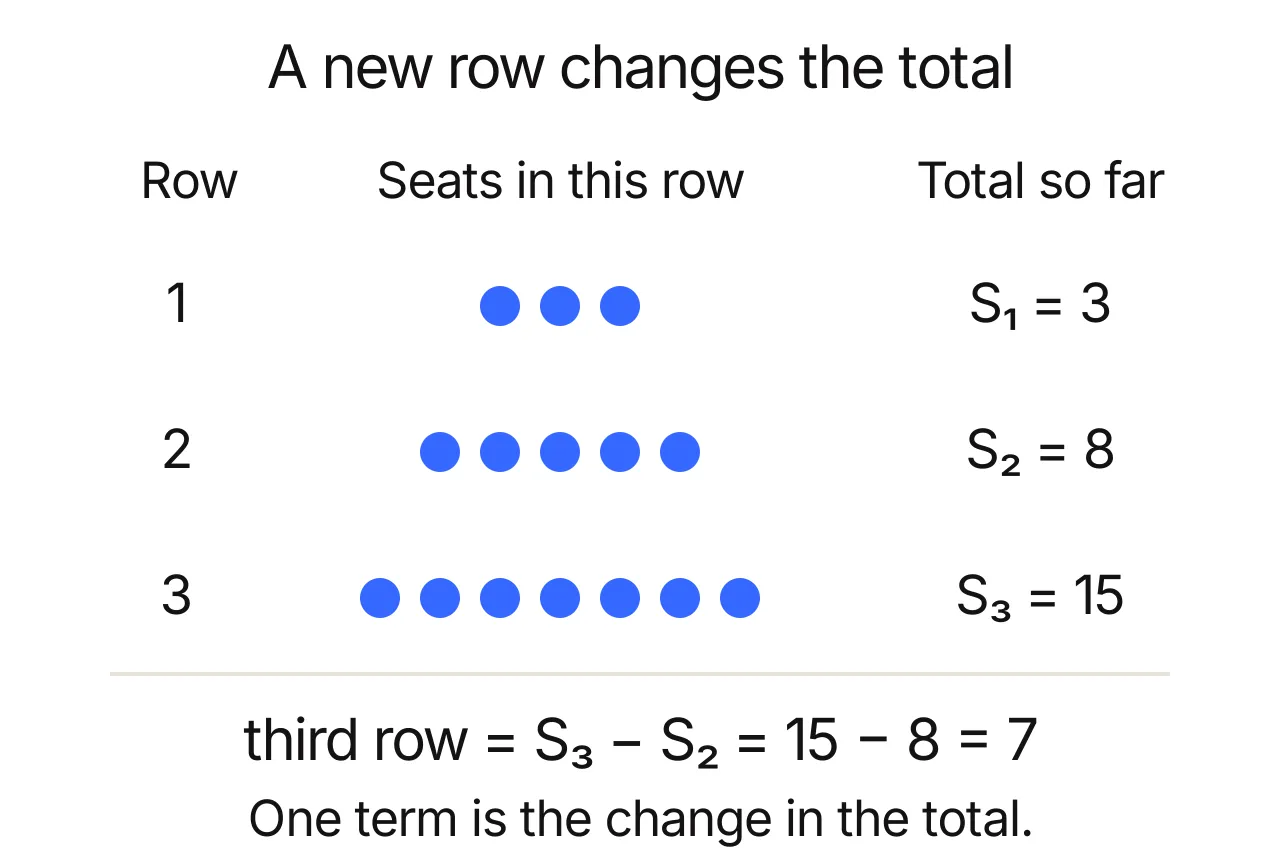
Let tₙ mean the number of seats in row n. Let Sₙ mean the total in the first n rows. These symbols describe different things. For the first three rows, t₁ = 3, t₂ = 5 and t₃ = 7, while S₁ = 3, S₂ = 8 and S₃ = 15.
Suppose you know only the totals. The first three rows contain 15 seats and the first two contain 8 seats. Subtracting removes the first two rows. What remains is exactly the third row: 15 − 8 = 7.
Subtract two neighbouring totals
The same reasoning works for any list of numbers, whether or not it is an AP. Sₙ contains the first n terms. Sₙ₋₁ contains all of those except the last. Therefore tₙ = Sₙ − Sₙ₋₁.
For n = 1, use S₀ = 0: the sum of no terms is zero. Then t₁ = S₁. If a supplied formula for Sₙ is stated only for positive integers, check that first term separately before extending the formula to n = 0.
In the seating example, Sₙ = n² + 2n. Replacing n with n − 1 gives Sₙ₋₁ = (n − 1)² + 2(n − 1) = n² − 1. Their difference is tₙ = 2n + 1. Putting n = 1, 2 and 3 gives 3, 5 and 7, matching the actual rows.
If only one total is given, use the endpoints
Sometimes we are told one AP sum, rather than a formula for every Sₙ. Then subtraction of neighbouring totals is unavailable. We can instead use the fact that the terms change by equal steps.
For our four rows, pair the first and last: 3 + 9 = 12. Pair the middle two: 5 + 7 = 12. Every pair has the same sum because one term moves up by 2 while the other moves down by 2.
If an AP has n terms, first term a and last term L, its sum is Sₙ = n(a + L)/2. One way to see why this also works for odd n is to write the list twice, once forwards and once backwards. The two lists make n pairs of value a + L. Divide their combined total by 2.
There are n − 1 steps from the first term to the last, so L = a + (n − 1)d, where d is the common difference. Once L is known, d = (L − a)/(n − 1), provided n is greater than 1.
Square the terms after recovering them
The opening question asks for t₁² + t₂² + ⋯ + t₁₀². It does not ask for S₁₀². Squaring a total introduces cross-products: for example, (3 + 5)² = 64, while 3² + 5² = 34.
If the recovered term has the form An + B, square that expression first: (An + B)² = A²n² + 2ABn + B². Then add each part over n = 1 to 10. Use the sum of the squares, the sum of the integers, and ten copies of the constant term. This is the same habit of simplifying one term before adding.
Try the past questions
1. An AP has 30 non-negative terms and first term 10/3. Its total equals the cube of its last term. Find its common difference.
Adapted from JEE Main, 4 April 2026 Shift 1 Q7, question ID 695278232.
Show hint
Call the last term L. The endpoint formula gives 15(10/3 + L) = L³. Try L = 5, then factor to check whether another real value is possible.
Show solution
The equation is L³ − 15L − 50 = 0, or (L − 5)(L² + 5L + 10) = 0. The quadratic factor has discriminant 25 − 40 = −15, so it has no real zero. Thus L = 5.
There are 29 steps, so d = (5 − 10/3)/29 = 5/87. Every term is positive, and the total is 15(10/3 + 5) = 125 = 5³.
2. Return to the opening question: Sₙ = 3n² + 5n. Find the sum of the squares of the first ten terms.
Show hint
Expand Sₙ₋₁ = 3(n − 1)² + 5(n − 1), subtract it from Sₙ, and only then square the result.
Show solution
We get Sₙ₋₁ = 3n² − n − 2. Hence tₙ = 6n + 2. The first term is 8, which also equals S₁, so the formula includes the first term correctly.
Now tₙ² = 36n² + 24n + 4. Summing for n = 1 to 10 gives 36 × 385 + 24 × 55 + 4 × 10 = 15220.
The terms are 8, 14, 20, …, 62. Their common difference is 6; their total is 350. That total and the requested sum of squares are different quantities.
The answers agree with the NTA final key, question IDs 695278232 and 695278302.